

Most of us grew up with a simple ritual: step on the bathroom scale, look at the number, and decide whether to feel good or guilty. But that single number can be deeply misleading. Two people can have exactly the same BMI and the same weight, yet look and feel completely different.
That’s where a Body Composition Analyzer changes the conversation. Instead of judging your health by kilograms alone, it shows what’s actually inside: muscle, fat, water, and more. For many guests combining beach days and wellness treatments in Phuket, this kind of assessment becomes a powerful baseline before planning weight management, toning, or detox programs.
Body Mass Index (BMI) is simply weight divided by height squared. It’s quick, cheap, and easy to calculate, which is why it became the standard screening tool for “underweight,” “normal,” “overweight,” and “obese” categories worldwide.
However, major organisations now emphasise that BMI has serious limitations:
- It does not directly measure body fat.
- It cannot distinguish muscle from fat.
- It does not show where fat is stored (for example, abdominal vs hip).
According to the U.S. Centers for Disease Control and Prevention, BMI is useful for screening, but it does not directly assess body fat or distribution and should not be used as the only diagnostic tool. CDC – About BMI
A global expert panel similarly notes that BMI is “associated with but not a direct measure of body fat” and that its link to health risk varies by age, sex, and ethnicity. nationalacademies.org This is one reason why some people with a “normal” BMI may still have metabolic risk, while others with “high” BMI but high muscle mass may be perfectly healthy.
In short: BMI is a rough map, not a detailed scan. For personal health and aesthetic planning, it’s often not enough.
What Body Composition Really Tells You
Your body composition describes how your total weight is divided into different compartments, typically including:
- Skeletal muscle mass
- Body fat mass (and sometimes visceral fat estimate)
- Total body water (intracellular vs extracellular)
- Bone mineral content
- Basal metabolic rate (BMR) estimates
Two people can share the same BMI but have dramatically different compositions:
- Person A: higher muscle, lower fat – often leaner and stronger.
- Person B: lower muscle, higher fat – especially around the trunk or abdomen.
From a medical and aesthetic perspective, this difference matters more than BMI alone. Fat distribution, muscle mass, and hydration status all influence health risks, recovery, and how treatments respond over time.
How a Body Composition Analyzer Works
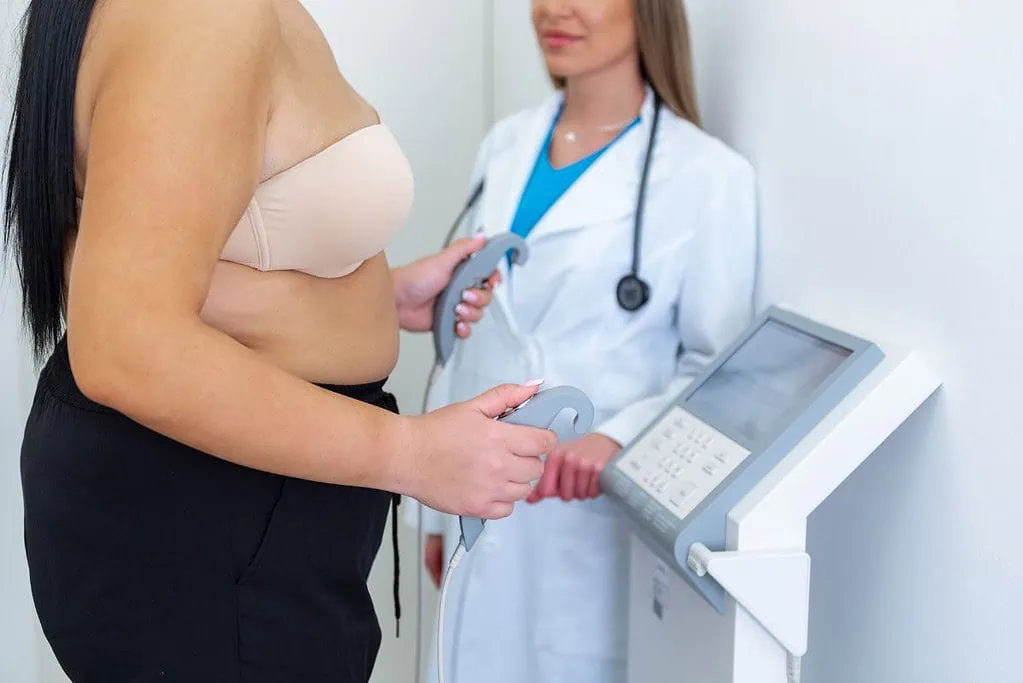
Modern Body Composition Analyzers in clinics usually use bioelectrical impedance analysis (BIA). A very small, safe electrical current passes through the body and measures how easily it travels through different tissues.
- Muscle, which is rich in water and electrolytes, conducts electricity well.
- Fat resists the current more strongly.
By combining these measurements with your height, sex, and age, the device estimates muscle mass, fat mass, and water distribution.
Clinical research shows that BIA is widely used and offers practical, reasonably accurate assessments when validated equations and standardised protocols are followed. It is not perfect, and high-level imaging such as DEXA scans remain the gold standard, but for most people in a clinic setting, a high-quality analyzer provides detailed and actionable information far beyond BMI.
For guests considering more advanced wellness programs (for example, metabolic support or cellular energy therapies), having a precise baseline from a Body Composition Analyzer allows the medical team to monitor changes over time.
BMI vs Body Composition: Why Weight Scales “Lie”
1. Muscle vs Fat
Traditional scales and BMI cannot see whether a kilogram belongs to muscle or fat.
- Someone who trains regularly may weigh more but actually be leaner and healthier.
- Another person with little muscle but higher fat mass may have a “normal” BMI yet carry more metabolic risk.
A Body Composition Analyzer helps reveal whether your weight gain after a training program is a good sign (more muscle) or a warning sign (more fat, especially around the abdomen).
2. Fat Distribution and Health Risk
Visceral fat around internal organs is more strongly linked with heart disease and metabolic conditions than fat stored around hips or thighs. Studies increasingly highlight that waist-to-hip ratio and fat distribution are critical predictors of risk, beyond BMI alone.
Some analyzers can estimate visceral fat levels and trunk fat percentages, giving a more nuanced picture than a single BMI number ever could.
3. Hydration and Fluid Balance
BMI is blind to fluid status. Body composition analysis, however, can show:
- Total body water
- Balance between intracellular and extracellular fluid
This is particularly important in tropical climates like Thailand, where heat and humidity can lead to rapid dehydration or, in some cases, fluid retention. A beach day in Phuket with strong sun, cocktails, and salty food can shift your water balance significantly — a factor that a Body Composition Analyzer can help track when interpreted by a medical professional.
4. Ageing, Sarcopenia, and “Skinny Fat”
As we age, we often lose muscle and gain fat, even if body weight stays similar. BMI alone rarely picks this up. A body composition assessment can identify:
- Early loss of muscle mass (sarcopenia risk)
- “Normal weight obesity” – normal BMI but high body fat percentage
This helps guide healthy ageing plans, from tailored exercise to nutrition and appropriate clinic-based wellness treatments.
Using a Body Composition Analyzer in a Phuket Wellness Journey
For many international visitors, Phuket is not only a beach destination; it is also a place to reset their lifestyle and health routine. When used appropriately, a Body Composition Analyzer becomes a central tool in that reset.
Before You Step on the Analyzer
To get more reliable results, it’s helpful to:
- Avoid heavy meals and alcohol for several hours beforehand.
- Stay well-hydrated, but don’t drink large volumes of water immediately before the test.
- Try to schedule the assessment at a similar time of day if you will have multiple scans during your stay.
- Inform the medical team if you have any implanted electronic devices or specific medical conditions.
After a long-haul flight into Phuket, it’s often best to rest, hydrate, and let your body stabilise before performing detailed measurements.
What Happens During the Assessment
In a premium clinic setting, the experience is usually comfortable and efficient:
- You will be asked to remove shoes and metallic objects.
- You stand or lie on the analyzer, placing your hands and feet on specific electrodes.
- The scan itself typically takes less than a minute.
- Results are printed or displayed as easy-to-read charts showing muscle, fat, water, and segmental distribution (arms, legs, trunk).
A physician or trained practitioner then interprets the results together with your medical history, lifestyle, and goals. From there, they may recommend a combination of:
- Nutrition and hydration strategies suited to a tropical environment
- Personalised exercise or physiotherapy
- IV hydration or wellness drips where appropriate
- Non-invasive body-contouring or firming treatments to complement your lifestyle work
Iron Intravenous – Siam Clinic Thailand
When to Consider a Professional Body Composition Assessment
A medically supervised body composition analysis may be helpful if:
- You are starting or adjusting a weight-management or body-shaping program.
- Your BMI is “normal,” but you feel low in energy, soft around the midsection, or concerned about health risks.
- You have been exercising but the scale barely moves, and you want to know if you are gaining muscle and losing fat.
- You’re visiting Phuket and want to use your holiday as a turning point for better long-term habits.
- You simply want a clearer, more detailed understanding of your body than BMI can offer.
Results are interpreted individually, and the goal is not perfection on paper, but a realistic, sustainable plan that respects your lifestyle and medical background.
FAQ: BMI vs Body Composition Analyzer
1. Is BMI completely useless?
Not at all. BMI is still a useful screening tool for populations and a quick indicator of possible weight-related risk. Major organisations such as the World Health Organization and National Institutes of Health still use it as a starting point.
The problem is when BMI is used alone, without considering body composition, fat distribution, lifestyle, and clinical context.
2. How accurate is a Body Composition Analyzer?
High-quality analyzers using validated bioelectrical impedance technology have good precision and give valuable trending information over time. However, their absolute accuracy can vary depending on the device, equations used, and factors such as hydration status.
This is why interpretation by experienced clinicians is essential. The device is a tool, not a verdict.
3. Will one scan be enough to understand my health?
One scan provides a helpful snapshot. But the real power of a Body Composition Analyzer comes from comparing measurements over time: after lifestyle changes, nutritional adjustments, or body treatments. Trends tell us more than a single reading.
4. Can I do a body composition scan right after arriving in Phuket?
You can, but it may not reflect your “normal” baseline if you are jet-lagged, dehydrated, or swollen from a long flight. For many guests, it works better to rest, drink water, and have a light meal, then do the assessment within the next 24–48 hours.
5. Is it painful or invasive?
No. The test is non-invasive, quick, and painless. You will feel no electrical sensation.
6. Who should avoid BIA-based body composition analyzers?
Individuals with implanted electronic medical devices (such as certain pacemakers) or specific medical conditions may be advised to avoid bioelectrical impedance methods. A pre-assessment consultation is important to decide whether this technology is appropriate for you.
Recommended Next Reads
To deepen your understanding and plan your wellness journey, you might also like:
Sources
- Centers for Disease Control and Prevention (CDC). “About Body Mass Index (BMI).”
- National Academies of Sciences. “The Science, Strengths, and Limitations of Body Mass Index (BMI).”
- Ward LC. “Bioelectrical impedance analysis for body composition assessment: reflections on accuracy, clinical utility, and standardisation.” Nutrition. 2019.
- Hamilton-James K et al. “Precision and accuracy of bioelectrical impedance analysis for body composition.” Clinical Nutrition. 2021.
Written by: Siam Clinic Editorial Team
Last updated: 6 December 2025
Medical Disclaimer
- This article is intended for educational and informational purposes only.
- It does not replace personalised medical advice, diagnosis, or treatment.
- Clinical decisions should always be made in consultation with a qualified healthcare professional.
Learn more about how we create and maintain medical content:
Medical Content Policy
Contact Siam Clinic Phuket
- phone : 088-488-6718 and 093-692-5999
- Email : info@siamclinicphuket.com
- Facebook inbox : https://m.me/siamclinicthailand
- Instagram : https://www.instagram.com/siamclinic
- Whatsapp : https://whatsapp.com